
OnlyFans first-month discounts replace the opening payment with a lower promotional rate while the standard price stays fixed. This article explains how that two-stage pricing works, when the standard rate takes over, and how to calculate the true yearly cost before you commit. BestOnlyFans tracks these pricing patterns so readers can see what a subscription costs once the discount disappears. BestOnlyFans refreshes its rankings every month.
The base subscription price must sit between $4.99 and $49.99. The promotional first-month field sits outside that floor, which is why a $3 entry month is permitted while a recurring base rate below $4.99 is not. The two values are stored separately, and only the base rate determines what you pay after the opening period.
The Promotional Pricing Framework
OnlyFans stores the discount and the ongoing rate as separate values inside the same subscription record. The base price respects the platform floor of $4.99. The promotional price is exempt from that floor, so steep opening offers remain valid without altering the long-term rate. Once the promotional cycle closes, the base amount is applied automatically on every following renewal.
The platform charges the promotional amount once, then the base amount thereafter, with no averaging across months. The 20% platform fee applies to whatever the subscriber actually pays, so a promotional month returns less to the creator than a standard one.
| Pricing Stage | Creator-Set Amount | Platform Floor |
|---|---|---|
| Promotional first month | Can sit below $4.99 (e.g. $3) | No hard floor on promo entries |
| Standard base subscription | $4.99 to $49.99 | $4.99 minimum |
| Typical paid range | $4.99 to $15 | Averages cluster $5-$10 |
| Free page | $0 base | Earns via PPV and tips |
Promotional Math: From $3 Entry to Standard Renewal
A $3 first month followed by a $10 recurring base rate totals $13 across two months. Extended over a year at the standard rate, the same subscription runs $113: the $3 entry plus eleven renewals at $10. After cancellation, a returning subscriber normally rejoins at the base rate unless the creator launches a fresh promotion.
- Single promotional month with cancellation: pay $3, cancel before renewal, total outlay $3.
- Multi-month retention at standard rate: $3 first month plus $10 per additional month; six months totals $53.
- Promotional stacking via creator bundles: separate pages can each run a promo, but every subscription renews independently at its own base rate.
- Annual equivalent cost: $3 plus eleven standard renewals at $10 equals $113 per year.
The common miscalculation is comparing the promotional month to the annual figure and treating the entry price as representative. A $3 opening feels trivial; the $113 yearly total is what retention actually costs. Running the same arithmetic with a $5 base gives $58 per year, and a $15 base gives $168 per year, which shows how quickly the recurring amount dominates the total.
Tip: multiply the recurring base rate by twelve before subscribing. If that annual figure does not fit your entertainment budget, treat the promotional month as a one-off trial and set a cancellation reminder for day 25.
Auto-Renewal Triggers and Price Transitions
When the promotional period closes, the platform charges the base rate without requesting fresh confirmation. The subscriber does not accept a new price each month, because the transition is written into the original subscription terms.
A creator-initiated price increase behaves differently. When the base rate itself is raised, auto-renew stops, existing access lasts until the paid period ends, and the subscriber must actively re-subscribe at the new amount. That safeguard does not cover the promotional-to-standard shift, since the standard rate was disclosed at signup.
- Automatic standard rate application: the base price replaces the promo price on the next billing date.
- Advance notification timing: renewal reminders appear in subscription settings before the charge date.
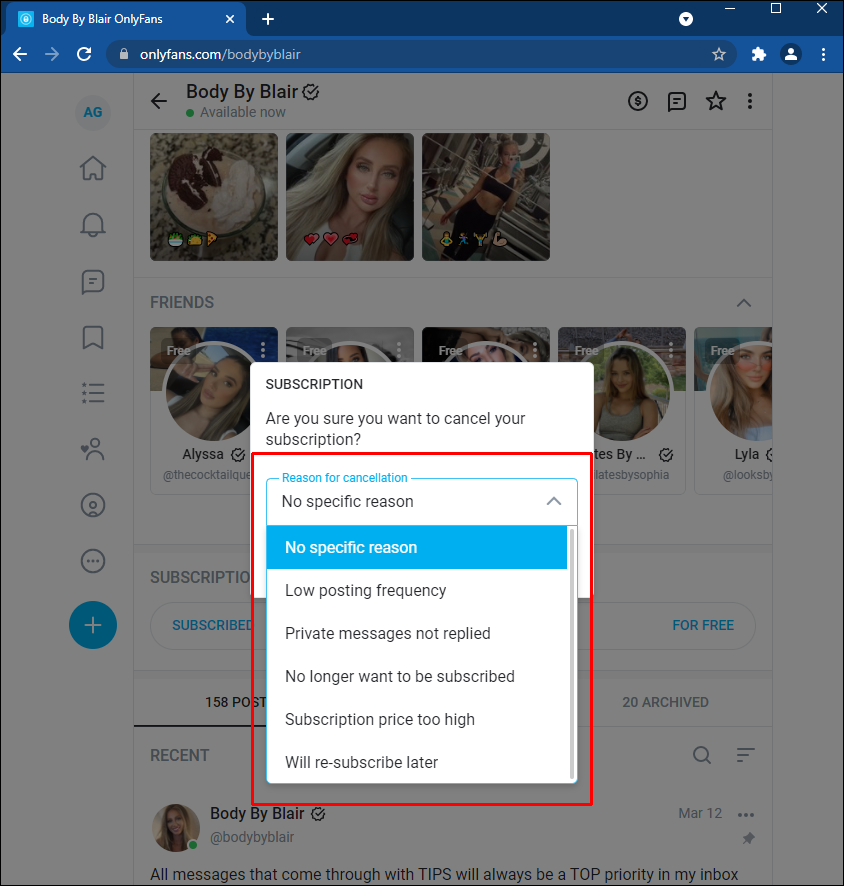
- Cancellation window: cancel any time before the renewal date to avoid the standard charge.
- Wallet balance priority: a stored wallet balance may cover the renewal before your card is charged.
A topped-up balance can quietly absorb the standard charge, so subscribers who meant to cancel should review the wallet alongside the linked card. Card verification places a $0.10 hold that is refunded within days and has no bearing on subscription pricing.
Reading Promotion Signals on External Rankings
OnlyFans has no built-in discovery feed or directory, which is why third-party ranking pages exist at all. Those pages often become the only place where promotional status, current price, and historical price appear side by side. A listing may show a single figure, a price history, or an explicit note that a discount is active.
Reliable rankings separate three data points: the promotional entry price, the recurring base rate, and the date the promotion was last verified. When a listing shows only one number, you cannot tell whether it is the discount or the ongoing rate. Promotional status also interacts with content volume, since a permanently discounted page may be compensating for sparse posting.
Presentation quality across these directories varies widely. Sites that invest in good onlyfans headers usually label promotional badges clearly, which makes price history easier to read at a glance.
Budgeting for the Promotional to Standard Shift
Treat the promotional month as a trial with a known end date rather than as the subscription’s real price. The discount only changes the first payment.
If a $10 base rate fits comfortably, a $3 opening month is a bonus rather than a commitment. If $10 does not fit, the promotion is a delayed cost rather than a saving.
- Promotional expiration calendar alerts: set a reminder two days before renewal.
- Standard rate affordability check: confirm the base price fits your monthly cap before subscribing.
- First-month-as-trial mindset: decide at signup whether you will continue at full price.
- Annual commitment thresholds: define the maximum yearly total you will spend on one creator.
A single threshold rule handles most cases: if twelve times the base rate exceeds your annual cap for one creator, cancel before the first renewal. The platform fee does not change that calculation, since it is deducted from the creator’s side rather than added to your payment.

Creator Strategies Behind Promotional Pricing
A larger subscriber base improves visibility on ranking sites and creates more chances to sell pay-per-view content and collect tips. The discount is an acquisition cost, recovered through other revenue lines rather than through the subscription itself.
Monetization after entry usually shifts toward PPV messages, which unlock for up to $50, and paid chat, which commonly runs $3-$5 per message. Tips can reach $100. A subscriber acquired at $3 can therefore generate far more than $3 across those channels.
| Creator Goal | Discount Depth | Revenue Recovery Mechanism |
|---|---|---|
| Fast subscriber growth | Deep promo, $3 first month | PPV messages and tips |
| Ranking visibility | Moderate promo, $5-$7 entry | Renewals at the standard rate |
| Audience testing | Short promo windows | Paid chat at $3-$5 per message |
| Retention focus | Minimal discount | Full base rate from month one |
Free pages follow a related logic: the base price is set to $0 and earnings come entirely from PPV messages and tips. Some creators keep a promotional field active for months at a time, refreshing the discount rather than lowering the base rate. Renewing subscribers may continue at the reduced amount while the promotion is live, but the standard rate remains the default position.
Subscriber Tactics for Promotional Navigation
Promotions are ordinary marketing, and using them well is mostly a matter of timing and honesty. Subscribe when the content genuinely interests you, evaluate during the promotional month, and base the renewal decision on that experience rather than on the discount alone.
Creators adjust promotions based on subscriber behavior, and clear feedback about perceived value helps them calibrate. What rarely helps either side is subscribing purely for the low price and never engaging with the page.
- Honest trial evaluation: judge the content across the full promotional month.
- Creator communication: share whether the standard rate matches your budget.
- Strategic timing: subscribe when a content drop is scheduled rather than on impulse.
- Transparent feedback: tell creators when pricing no longer fits your plans.
A $3 month that includes a major drop can deliver more than several standard months of sparse posting.
Long-Term Cost Comparison Methods
What matters is the base rate, the posting frequency, and the additional spending a page encourages. A cheap entry into a high-PPV page can cost more over a year than a full-price page with no upsells.
Cost-per-post analysis divides the base rate by the number of posts published each month. A $10 subscription with 30 posts works out to roughly $0.33 per post; the same $10 with only 5 posts comes to $2.
- Cost-per-post analysis: base rate divided by monthly post count.
- Equivalent entertainment spending: compare against streaming or music subscriptions.
- Engagement quality assessment: weigh replies, custom content, and interaction consistency.
- Opportunity cost: every subscription reduces budget available for other creators.
The $3 entry stops dominating the decision, and the recurring rate settles into its proper place. A page that costs $8 monthly with consistent posting often beats a $5 page that publishes twice a month once you run the numbers side by side. The BestOnlyFans approach applies the same arithmetic across every listing, so comparisons rest on the base rate rather than the discount.
FAQ
Can I get the promotional price again after canceling?
Usually not right away. The promotional field applies to new subscriptions, and returning subscribers normally rejoin at the base rate. A creator may launch a new promotion later, but there is no guarantee that a former subscriber qualifies for it.
How do I know what I’ll pay after the first month ends?
The base price is shown alongside the promotional price on the subscription page, and that figure is what renews. If the two numbers are not clearly separated, check the creator’s profile or a ranking listing that displays both the promo and the standard rate.
Why do some creators keep promotions running indefinitely?
It keeps the entry price low for new subscribers while the base rate governs renewals. Creators may refresh the discount field over extended periods to sustain growth on ranking sites.
Does canceling during a promotional month affect future access?
Canceling stops the next renewal, but access continues until the paid period ends. Everything included in the promotional month stays available, including content posted before expiry.
Reading the base rate first, multiplying it across the year, and deciding on renewal before the promotional period closes keeps a subscription budget predictable. Whether you stay for one month or twelve, the standard rate is the number that defines the real cost.